

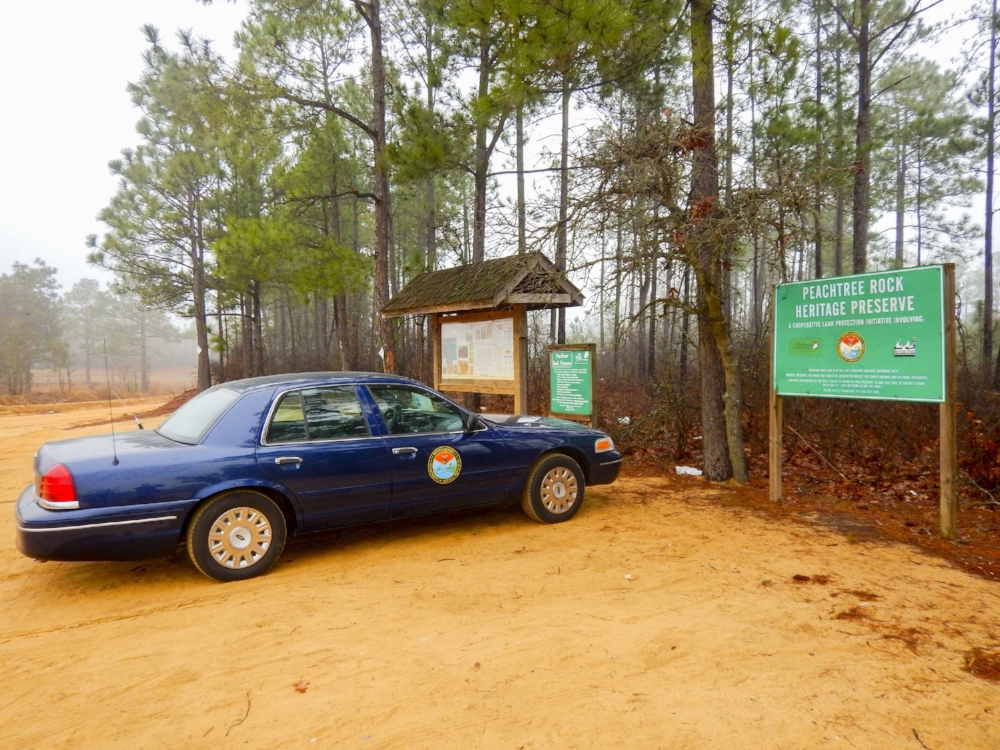
The parking area at Peachtree Rock Heritage Preserve in Lexingto County can get crowded on weekends — it’s a popular day-hike of moderate intensity that will nonetheless take you through some rapid changes in terrain and elevation in under a mile.
Nothing lasts . . . A half-remembered phrase from my college days I’m mulling over while Old Blue’s headlights cut through pre-dawn fog and drizzle on Highway 21. Pop philosophy for sure, but it’s so true — deep as folk music, as the saying goes —everything changes, constantly. Even those things we think are set in stone. Even memory. Driving these backroads never fails to make me feel nostalgic, but this morning particularly so, as I’m headed for a hike at a place I’ve been to many times before, though not in several years. Thinking about the past . . . hoping the sky clears long enough for me to make some photos to share on the S.C. Natural Resources Blog and wondering what I’ll find there.
Peachtree Rock Heritage Preserve, located off S.C. Highway 6 in Lexington County, is co-managed by the SCDNR and the South Carolina chapter of The Nature Conservancy and boasts an uncommon geology and associated terrain, including the only naturally occurring waterfall in the South Carolina coastal plain. The preserve is 460 acres, and the sandy uplands surrounding the steep creek valley where the waterfall and “Peachtree Rock” itself— one of the large sandstone outcroppings the preserve is known for — mainly consist of the mixed pines, turkey oak and sparkleberry and other understory species typical of this region. In late 2010, a tract of about a hundred acres of mature longleaf pine was added to the property’s footprint, and prescribed burning is used as a management tool to encourage the germination and growth of longleaf that has been planted in areas that were previously in cultivated slash pine.
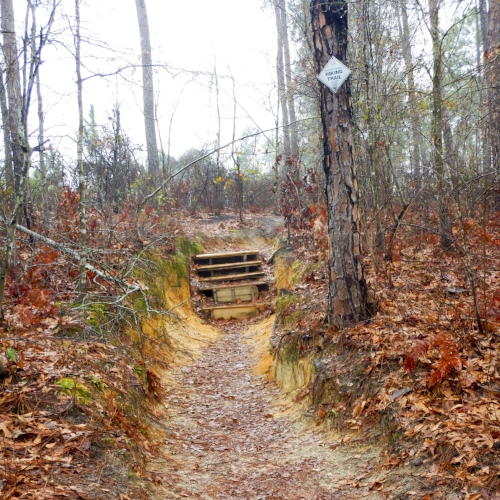
The sandy trail from the parking lot gets steep quickly, but stairsteps make the journey fairly easy. It’s a moderate hike of less than a mile to view the falls.
That work on the property’s upland areas is important from a management perspective, but for most visitors and day-hikers, the waterfall and rock formations are the main attraction, and on sunny weekends, the small, sandy parking lot can be crowded with vehicles. Millions of years ago, the ocean covered this ground before receding, and as a result there are ancient marine fossils and other geologic evidence of those inexorable processes in the sandstone outcroppings. That’s what I’m here to see too, and at 8:30 on an overcast weekday morning, it seems like I’ve got the place all to myself. I grew up not far away from here, and in my youth – long before this property was a part of the state’s Heritage Trust program – it was one of those “secret” destinations that get passed along through word of mouth, a popular, mainly locals-only spot. In college, I took roommates and friends from other places there, and they never failed to be blown away by the strange beauty of this mountain-like setting tucked into the heart of the Sandhills. But I hadn’t visited in a long time, and in 2013, something lousy, though inevitable, happened. Peachtree Rock itself, the preserve’s iconic namesake, crashed onto its side, the base of its inverted pyramid finally giving way to decades of natural erosion and helped along by people carving into the soft sandstone.
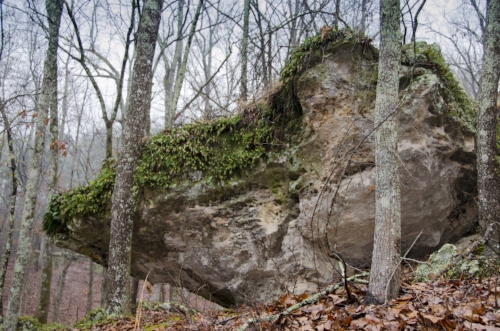
Along the way, you’ll see some spectacular rock formations, Hey! This one looks a little like South Carolina too.
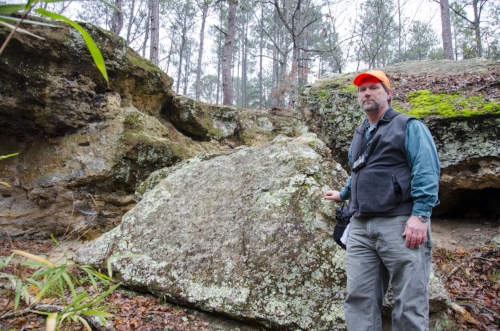
It took millions of years for these sandstone formations to develop, an amazing thing to ponder.
I was sitting at my desk in the South Carolina Wildlife magazine offices when I heard the news, and it was like hearing about the death of an old friend. It seemed like such a wonder, this huge sandstone outcropping (shaped vaguely like the Palmetto State – or maybe a peach tree, depending on who you asked) tapering down to an impossibly narrow and fragile-seeming base. How could it remain standing for so long, in seeming defiance of gravity and time? It was a thought-provoking setting, perfect for inspiring philosophical discussions or dreaming about the future. And then . . . well, “Nothing lasts.” I didn’t visit again after that. Didn’t want to see it, to be honest, a picture was enough. So I wasn’t too sure what I would find at the end of the trail here in 2017, or how I would feel about it when I got there.
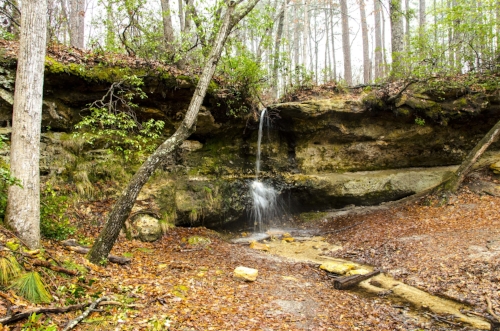
Nope, you’re not in the mountains, just looking at the only naturally occurring waterfall in the South Carolina coastal plain.
On the trail from the parking lot, the white sand and scrub oaks of the preserve’s uplands give way fairly quickly, and it begins to cut a steep path down through the valley. Soon, rock outcroppings begin to appear, and by the time the trail crosses the creek over a small bridge, it seems like you’ve entered another world. Mountain laurel and tulip poplar begin to appear mixed in among the more familiar plants and trees of the sandy Midlands. On rock outcroppings, lichens, and even resurrection fern make an appearance – the abundant recent rains have it really prospering — a strange mix of mountains and Lowcountry — right at the Fall Line. When I break out of the trees on the ridge top across from the waterfall (itself a very cool feature), I can see the big rock lying on its side, with new fencing around it cautioning visitors not to climb. And I am, surprisingly . . . not sad at all. It’s true; Nothing lasts! Maybe off its narrow pedestal Peachtree Rock has lost a little of its power to awe, but it’s still an impressive sight, and something about the way its situated now, with the underside more visible and continuing to erode, evokes the inevitable forces by which the natural world changes and evolves over the course of eons even more powerfully. It’s cool.
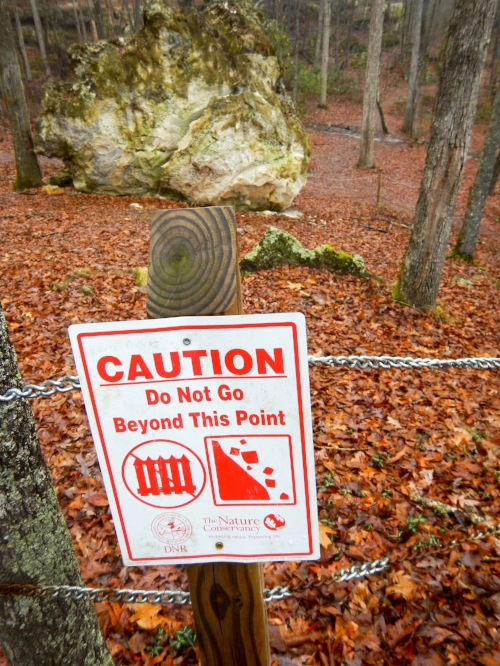
The underside of a toppled Peachtree Rock.
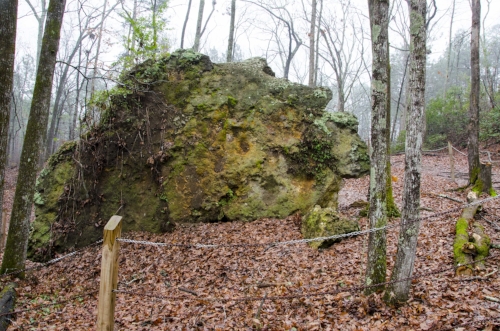
Side view of what was once the top of Peachtree Rock.
The waterfall is still splashing its way downhill to the Congaree River and its eventual rendezvous with the Atlantic Ocean. The surrounding rock formations are still mysterious and beautiful. There’s even a “Little Peachtree Rock” on another part of the preserve, its narrow base also in the process of eroding away over time. This is still a place for inspiration and for dreams, and I find that I am mostly feeling glad that I live in a state where citizens, government and non-profit conservation organizations have decided that this place and others like it are worthy of protecting. The South Carolina Heritage Trust program is a remarkable achievement, and properties like this one exist all across this great state. I hope to visit them all and share them with you on this blog, but why wait. Your next beautiful adventure is already waiting for you.
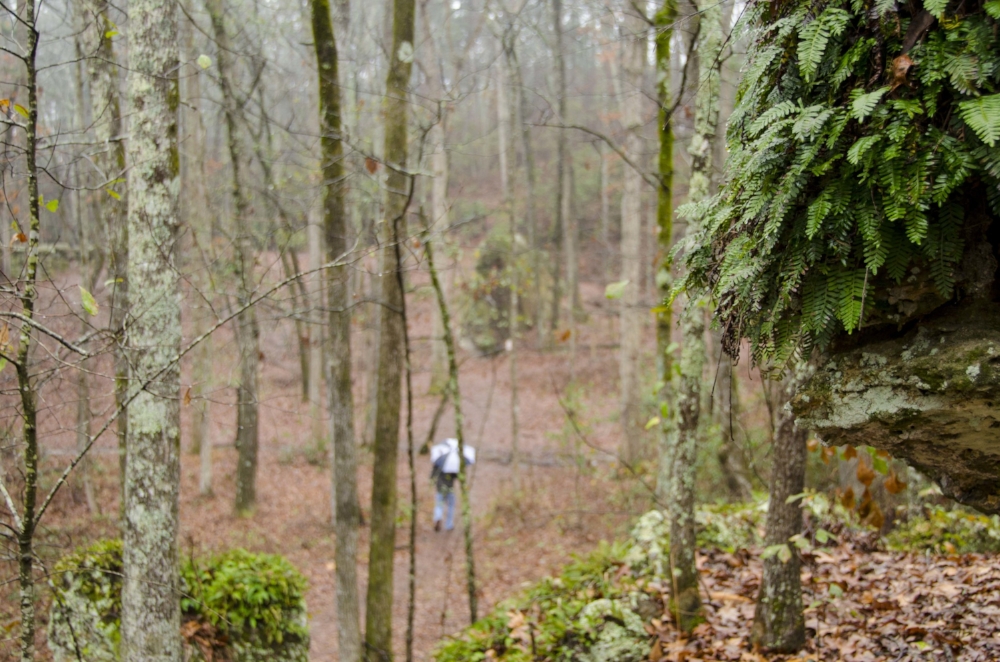
Rain or shine, one of the many hiking trails available on SCDNR-managed lands around the state is waiting for you. Visit http://www.dnr.sc.gov and click on “public lands” to find your next adventure.
 SCDNR Blog