
The world of marine animal reproduction is as bizarre and varied as the animals themselves. South Carolina’s coast is home to animals that clone themselves, animals that change sex, and animals with complex, multi-stage life cycles. There are fish that embrace, fish that dance, and fish that bite, all in the name of reproduction.
In honor of Valentine’s Day, we’re celebrating some of the peculiar and fascinating examples of courtship and mating behaviors that happen in our coastal waters.

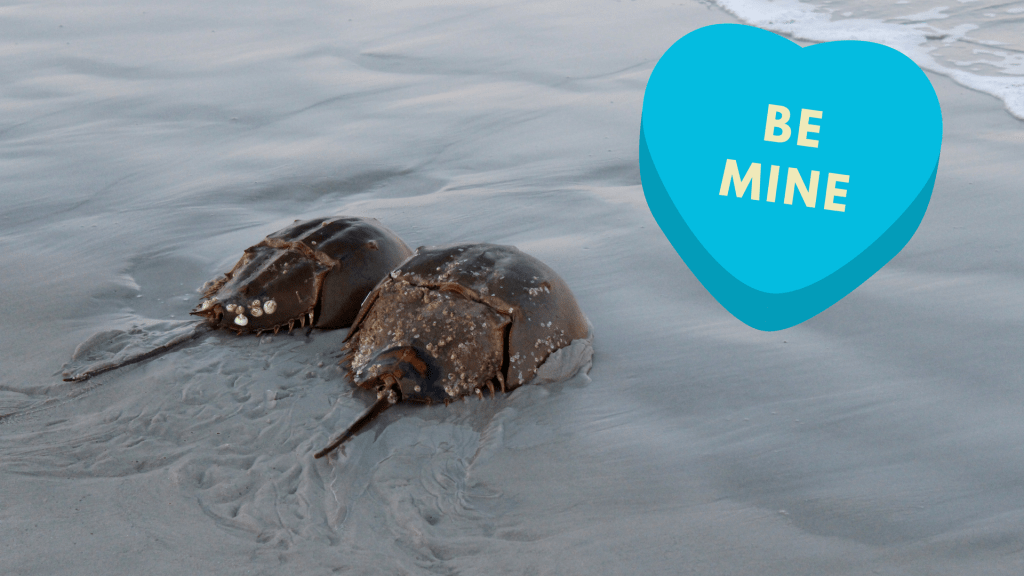
There are only one or two females horseshoe crabs in this photo of daytime mating — the rest are males vying for a chance to fertilize the small, greenish eggs she’ll lay in the sand. (Photo: E. Weeks/SCDNR)
Horseshoe Crabs
Their association with the moon and affinity for long crawls on the beach make the horseshoe crab sound like a romantic cliché, but these ancient animals have been around for 300 million years longer than personal ads.
Horseshoe crabs (Limulus polyphemus) rely on the lunar cycle to come ashore and mate en masse on sandy Atlantic beaches. Females are typically trailed by numerous males, only one of which will clasp onto the back of her shell before she deposits eggs in the sand. You might feel sorry for the many satellite males roving around in vain for a partner, but interestingly, research has shown both of these strategies to be successful – in one study, satellite males actually succeeded in fertilizing far more eggs than attached males.

Both male and female toadfish make grunting sounds, but only males broadcast a characteristic foghorn sound across the seafloor. (Photo: E. Weeks/SCDNR)
Oyster Toadfish
The oyster toadfish (Opsanus tau) has a face only a mother could love – but a baritone that charms other toadfish.
These fleshy, scaleless fish can thrive in polluted waters, and males choose secluded nest sites among natural or manmade debris. Holed up in his nest, a male calls in females with a characteristic “boatwhistle,” a deep grunting sound not unlike a foghorn (listen to a recording here). He’ll then guard any eggs laid by females impressed with his home decor, fending off predators even after the eggs hatch. What’s most remarkable about the male toadfish’s boatwhistle are the superfast swimbladder muscles that vibrate to produce it – they’re the fastest-known muscles among vertebrates and have been the subject of extensive acoustic research.

This mature male blue crab, or jimmy, was collected on an SCDNR crustacean trawl. (Photo: E. Weeks/SCDNR)
Blue Crabs
When water temperatures warm in spring, female blue crabs (Callinectes sapidus) move into the upper reaches of estuaries to do two things – molt and mate.
When male blue crabs encounter these nearly mature females, they fan pheromones through the water to advertise their interest, sometimes with a bit of shimmying or swaying on their walking legs. Receptive females wedge themselves beneath the male, who then uses his walking legs to cradle the female in a protective stance. This ensures that as soon as she sheds her hard exoskeleton, the male will be present to mate and protect the female from predators that enjoy softshell crab. Males continue to cradle females until their shells harden, meaning these “doublers,” as crabbers call them, can sometimes stick together for over a week.
Hogfish
Hogfish (Lachnolaimus maximus) are prized by anglers for their tasty meat and known for their striking looks. Males sport a deep burgundy stripe from their snout-like mouth to the first of their dorsal spines – but none of them start out that way. Hogfish belong to a group of fish that start their lives as females; some then become males as they grow larger and more socially dominant.
In the above video captured by SCDNR scientists on a research cruise, you’ll see a male hogfish swoop in and flirt with a small group of females. As he approaches each female, he gives a vigorous shake of his dorsal spines and pectoral fins. The clip doesn’t last long enough to show if his mating display is successful, but the females seen are likely part of his “harem,” a group of females that school and mate exclusively with one male. If a male dies, he’ll be succeeded by another female-turned-male in the group.

Three Spurilla braziliana nudibranchs that SCDNR biologists found on a crab pot during an inshore shark survey. (Photo: E. Weeks/SCDNR)
Nudibranchs
Nudibranchs are a type of sea slug that are small, slow, and solitary – which presents them with a dilemma. Although the seas are home to thousands of nudibranch species, it can be challenging for members of the same species to find one another in the vast oceanic space. The nudibranch’s solution to this problem is hermaphrodism: all nudibranchs have both male and female sex organs, thus granting them the ability to mate with any member of their species they encounter. This maximizes their chances of reproductive success, and it’s a strategy that’s not uncommon among marine invertebrates.

A female tiger shark tagged by SCDNR biologists shows evidence of both recent mating wounds (dorsal fin) and older, healed scarring. (Photo: SCDNR)
Tiger Sharks
Shark reproduction involves much gnashing of teeth. Male sharks bite the dorsal side and fin of a female during courtship and mating, both to attract the female’s attention and to maintain the right position during mating. Researchers believe female sharks have evolved a fascinating response to this. In many species, their skin has been shown to be up to several times thicker than that of males.
SCDNR biologists have been studying South Carolina’s tiger sharks (Galeocerdo cuvier) for several years and have tagged several females with recent mating wounds – exciting finds that point to the importance of our waters for tiger shark reproduction.
 SCDNR Blog
Leave a comment