
Guest Blog by SCDNR Upstate Public Information Coordinator Greg Lucas
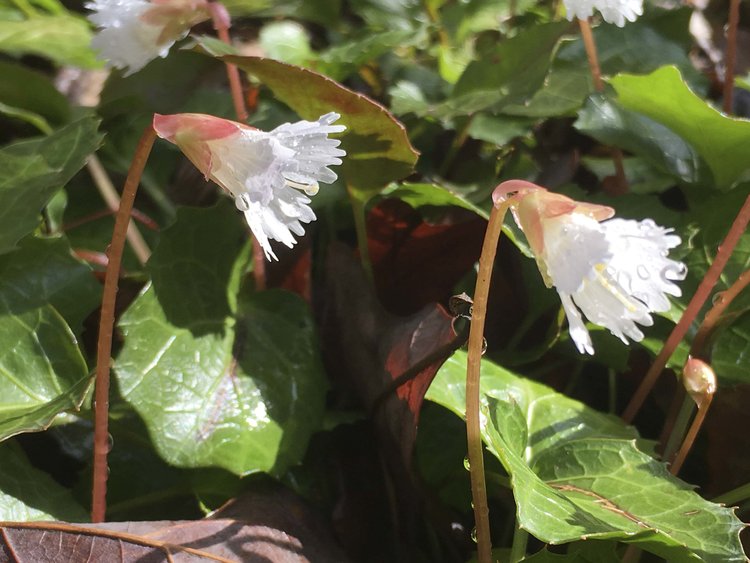
Early spring in the mountains of South Carolina provides a window of opportunity to see this rare plant with a curious history.
If seeing an iconic Oconee bell in full flower is on your South Carolina nature bucket list (and it should be), now would be a great time to make a visit to the SCDNR’s Jocassee Gorges Wilderness Area in the Upstate.
“Oh my, look at all the blooms!”
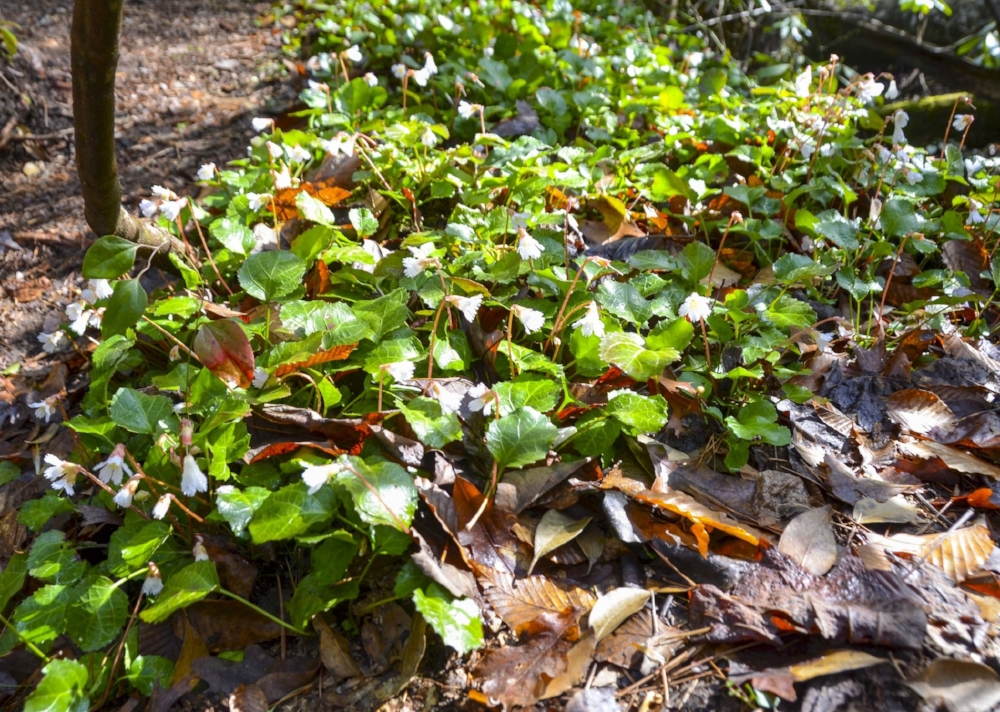
Indeed, as we neared the stream at the bottom of the hill, many of the Oconee bell plants along the waterway were in full, glorious flower. The excited comment about the Oconee bells was from one of the participants in the Osher Lifelong Learning Institute (OLLI) at Clemson University Jocassee Gorges class, which is conducted by the South Carolina Department of Natural Resources (SCDNR). On this day, we were joined by Dennis Chastain, noted mountain naturalist and frequent contributor to South Carolina Wildlife magazine, and his wife, Jane.
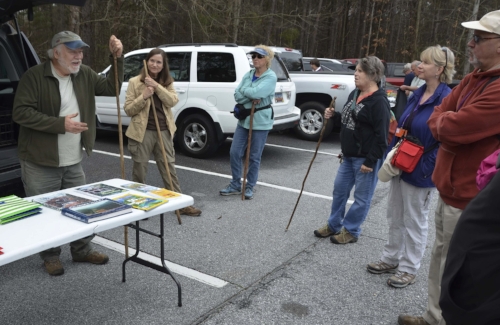
Dennis Chastain prepares to lead a Clemson University “OLLI” group on a trek to see blooming Oconee Bells.
During the course of our walk along the Oconee Bell Trail at Devils Fork State Park, Dennis tells the OLLI group the story of Oconee bells, describing how the famous French botanist Andre Michaux first discovered the plant in 1787 along the Keowee River near the location of today’s Lake Jocassee dam. Years later, a young American botanist named Asa Gray visited Paris and saw Michaux’s specimen of the plant at a museum. Recognizing it as an undescribed plant, Gray named it Shortia galacifolia in honor of Dr. Charles Short, a botanist in Kentucky. The species name, galacifolia, was chosen because the leaves look like those of galax. Even today, wildflower watchers still confuse those plants, and Dennis stops at a point along the trail where Oconee bells and galax occur side by side and spends a good bit of time explaining the difference.
“The veins in galax all radiate out from one point in the leaf,” he says, “whereas with Oconee bells, there is a central vein from where all other veins radiate. Now, if you can just keep straight which is which, you’ll have it licked!”
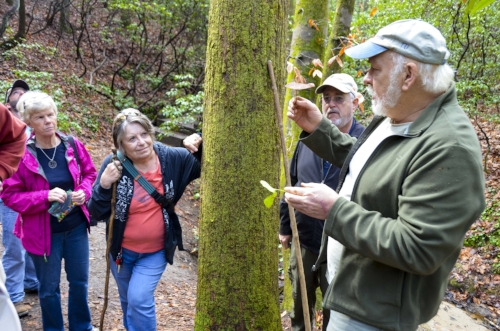
Galax or Oconee bell? When you habdg out with Dennis Chastain, you learn stuff. Here, Dennis shows the class the subtle differences in the leaves of the two plants.
Dennis explains that Asa Gray, who later became a pre-eminent botanist at Harvard University, spent the rest of his adult life searching for the place where Michaux found Shortia. Part of the confusion came from Michaux’s description that he found it in the “high mountains of the Carolinas.” Gray took that to mean the highest peaks of North Carolina, instead of where it actually lay, along the rivers and streams of the Jocassee Gorges in South Carolina. While Gray did eventually see Oconee bells in Catawba County, North Carolina, near the headwaters of the Catawba River, he never made it to Michaux’s collection point near the Keowee River. Thus the popular saying that the Oconee bell was, “Found by a man who didn’t name it, and named for a man who never saw it by a man who couldn’t find it.”
The flowers of the Oconee bell are beautiful, but they are small and near the ground. To photograph them, you need to get low. They also bloom for the most part only in March. In National Geographic’s publication “50 of the World’s Last Great Places,” which put Jocassee Gorges on the map, the two-page spread of Oconee bells makes the flowers look gargantuan, while in reality they are probably less than an inch in diameter. Chastain calls the plant “rare, but locally abundant.” By that he means that Jocassee Gorges is the only place in the world where the plant is found, but where you do find them, such as along the streambank at Devils Fork State Park, you find LOTS of them.
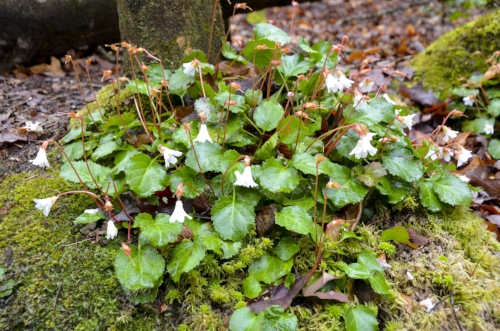
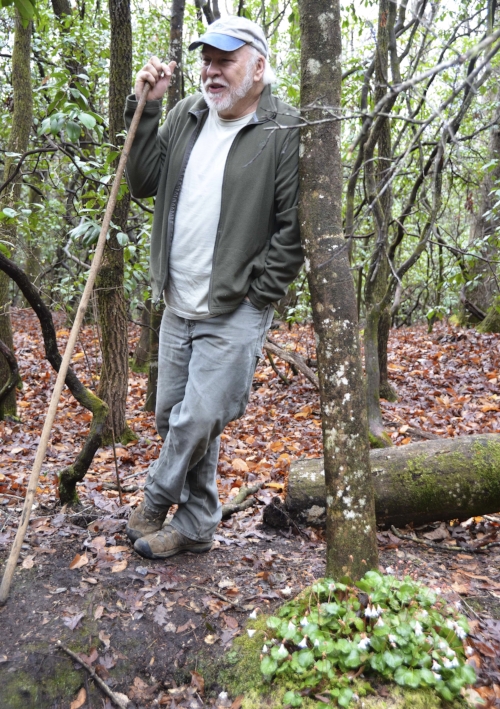
Dennis uses his ever-present hiking staff to point out a colony of Oconee bells (closeup above) springing up near the base of a hardwood tree near a streambed — exactly the habitat you should keep your eyes peeled for when searching for them.
Oconee bells are such a famous landmark in Jocassee Gorges, it has a festival named after it! The Friends of Jocassee (http://www.friendsofjocassee.org/) has for the last five years held BellFest, a celebration of Upstate South Carolina’s favorite native wildflower. Replete with music, food and tours of the wildflower on land and on the water, the festival is held in mid-March at Devils Fork State Park, typically near the peak bloom period for Oconee bells.
If seeing an Oconee bell in flower is on your Bucket List, you should plan to visit Devils Fork State Park in northern Oconee County by the end of March. They are most easily viewed along the Oconee Bell Trail near the park headquarters, and you only have to walk a few hundred yards to reach the wildflowers. Lake Jocassee is a spectacular reservoir, and the surrounding area offers many other worthy destinations. For more information, call Devils Fork State Park at (864) 944-2639 or visit the park’s page on the SCPRT website.
For more information on OLLI at Clemson University, visit https://www.olliatclemson.org/.
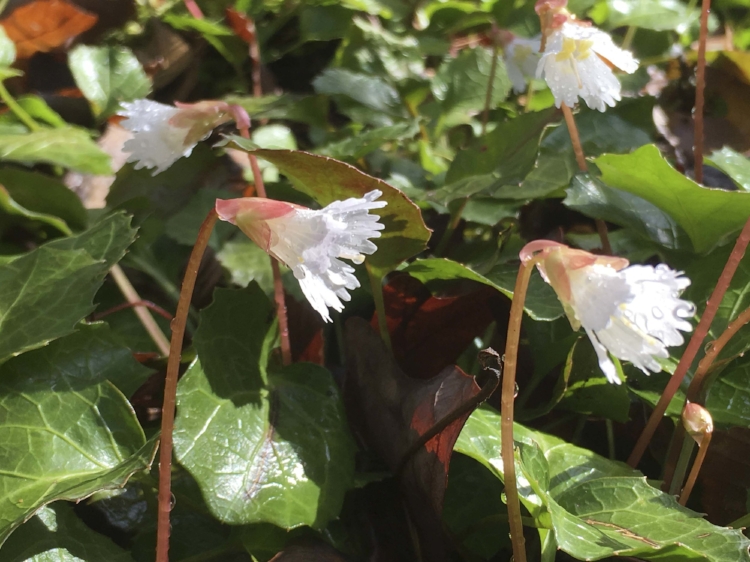
Is a visit to the SCDNR’s Jocassee Gorges on your must-do Palmetto State Road trips list? It should be, National Geographic named the Gorges one of its “50 of the World’s Last Great Places.”
 SCDNR Blog