
It was a little bit startling, the excited whoop that wildlife biologist Mark Pavlosky Jr. let out from the rear seat of the pickup truck as we crawled slowly along a two rut trail normally reserved for horses, hikers and runners at Aiken’s Hitchcock Woods.
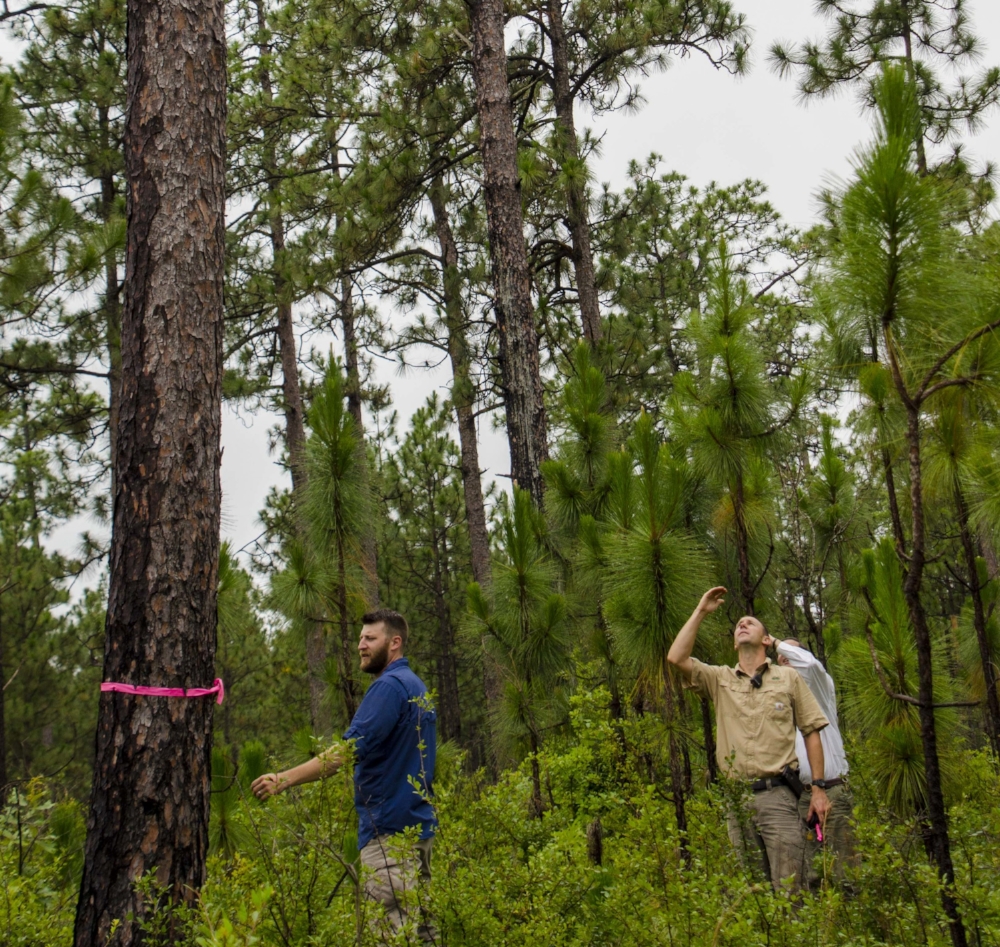
Wildlife biologist Mark Pavlosky (left), Hitchcock Woods Superintendent Bennett Tucker and Hitchcock Woods Foundation board member Randy Wolcott mark a tree where a red-cockaded woodpecker recently translocated to the property has begun excavating a cavity.
With a keen and practiced eye, Pavlosky had spotted—at a distance of at least 100 yards across a beautiful patch of widely spaced longleaf pine, mind you— a bright circle of raw wood about the size of a silver dollar high up in a mature tree, placed as neatly as if someone had clambered up a ladder with a brace and bit and bored it there (that’s what folks in the old days used to drill holes with, kids—no batteries needed). But this wasn’t the work of a rogue woodworker with a fetish for antique tools (though wouldn’t that have been the start of an interesting blog?). No, what had Pavlosky and the other folks in the vehicle so excited was that this small hole is EXACTLY the type of hole that indicates a red-cockaded woodpecker is starting to excavate itself a new home.
For Pavlosky and my other companions, this was incredible news. Confirmation that RCWs released on the property late last year are branching out in search of new nesting locations in addition to the ones carefully prepared for them by researchers working on the project.

With one of the property’s iconic “Aiken Jumps” (a style of obstacle that the horses leap over during a foxhunt) in the foreground, it’s easy to see the results that now several decades of intensive understory reduction have brought to the Hitchcock Woods.
The reason that I was riding along through the Woods with Pavlosky, Woods Superintendent Bennett Tucker and Hitchcock Woods Foundation board member Randy Wolcott on a somewhat drizzly June morning in the first place, is that I was, as is so often the case when I happen upon something really cool, on an assignment for South Carolina Wildlife magazine. Back last November, I visited the Hitchcock Woods for the first time ever, mainly to meet up with SCW editor Joey Frazier and take some pictures of the annual Thanksgiving Day morning “Blessing of the Hounds” sponsored by the venerable Aiken Hounds hunt club (of course) and held at the Wood’s Memorial Gate. It’s a neat event and an Aiken tradition, and if you’ve never been, I recommend it highly.
As we were leaving the event to head over the river and through the woods to grandma’s house to erase all the gains from a morning of burning calories through brisk walking and petting strange horses and dogs, Randy Wolcott introduced himself and started talking with us about the tremendous effort the Hitchcock Woods has undertaken over the last few decades to restore a large portion of the property’s uplands to the way they were prior to European settlement. An effort that culminated with the release of four pairs of RCWs “translocated” from the Francis Marion Forest. As it happened, I had recently met Mark Pavlosky at a translocation release at the SCDNR’s Donnelly WMA. So we got to talking about all this, and the upshot is we’ll be sharing an article outlining all of the amazing work going on at the Hitchcock Woods with the readers of SCW in the November-December 17 issue. In the meantime, here’s what a newly started RCW nesting cavity looks like.

This is the beginning of what could eventually be one of the first natural RCW nesting cavities in the Hitchcock Woods since the 1960s. Read more about it in the November December 2017 issue of South Carolina Wildlife magazine.
 SCDNR Blog