
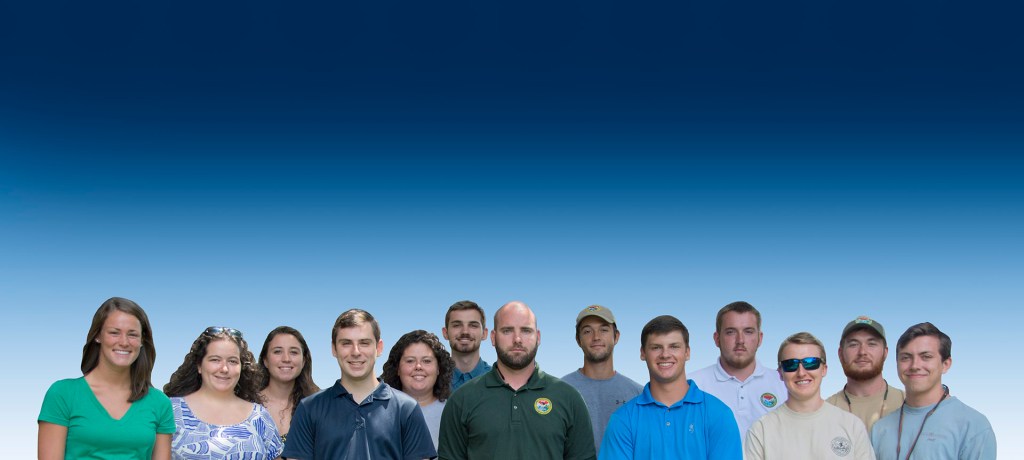
(Left to right) Ashley Padgett, Alexandra Norelli, Caroline Thompson, James Ingersoll, Madeline Jensen, Aaron Fewell, Jonathon Pritchard, Brian Sweeney, Mason Collins, Daniel Jones, Brett Kelly, Edward Stello, and Logan Bodiford
We asked our fisheries interns for their advice to aspiring fish and wildlife biologists. Here’s what they had to say.
[row cols_nr=”2″][col size=”6″]
Ashley Padgett
Clemson University
Everyone looks ugly in waders, don’t worry.
[/col][col size=”6″]
Alexandra Norelli
University of South Carolina
Take as many math and statistics courses as possible. They may be boring by they’re helpful in the long run.
[/col][/row][row cols_nr=”2″][col size=”6″]
Caroline Thompson
University of South Carolina
Seize every opportunity given to you to get exposed to experience in your field of interest.
[/col][col size=”6″]
James Ingersoll
University of South Carolina
Do as much as you can, especially things that are outside your comfort zone.
[/col][/row][row cols_nr=”2″][col size=”6″]
Madeline Jensen
University of South Carolina
Experience is more important than you think and it’s in areas you wouldn’t think of.
[/col][col size=”6″]
Aaron Fewell
University of South Carolina
Be prepared to get dirty and get up early!
[/col][/row][row cols_nr=”2″][col size=”6″]
Jonathon Pritchard
University of Georgia
Get involved in student and professional programs in your field of interest. Meet new people. Get your name out there.
[/col][col size=”6″]
Brian Sweeney
University of South Carolina
Work hard in school and make yourself available to different experiences and opportunities as you try to choose a career path.
[/col][/row][row cols_nr=”2″][col size=”6″]
Mason Collins
Clemson University
Don’t get discouraged about going into the fisheries field when people don’t think it’s a real job.
[/col][col size=”6″]
Daniel Jones
Clemson University
Make sure to “dip your toes” in various aspects of wildlife and fisheries in order to find your true passion.
[/col][/row][row cols_nr=”2″][col size=”6″]
Brett Kelly
Clemson University
Find a mentor in your field and learn as much as possible from them by volunteering for fieldwork, taking their classes, or by reading all of their work.
[/col][col size=”6″]
Edward Stello
Clemson University
Volunteer as much as possible and take time to get to know your professors, because they can help a lot when it comes to getting jobs, internships, or just useful connections.
[/col][/row][row cols_nr=”2″][col size=”6″]Logan Bodiford
Clemson University
You can’t fake experience/time out in the woods. Get outside.[/col][col size=”6″][/col][/row]
 SCDNR Blog