
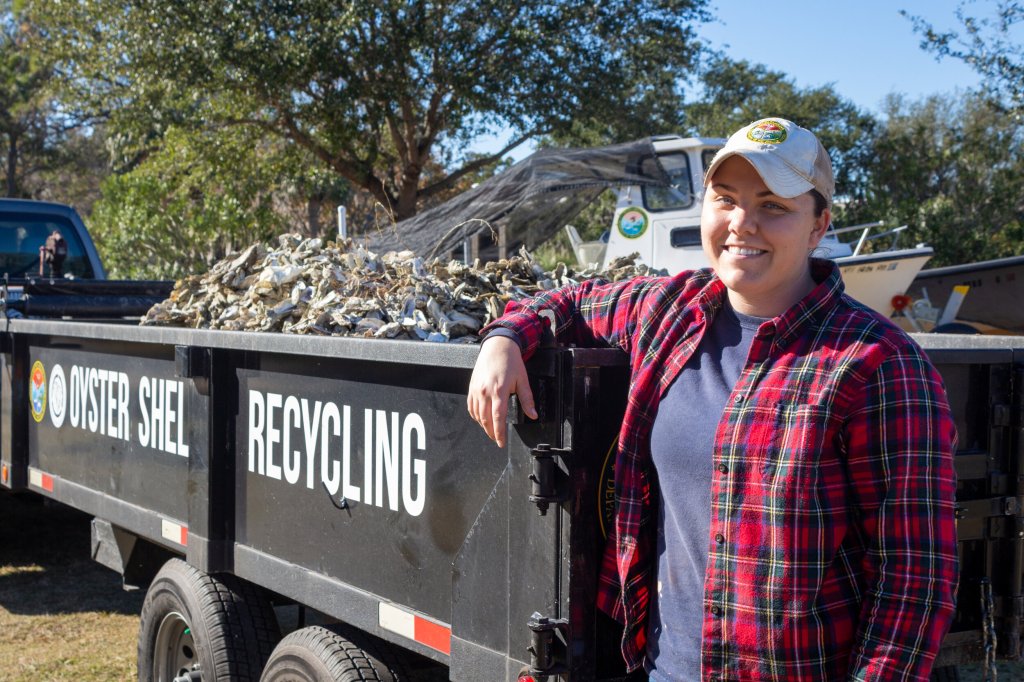
Oyster season is in full swing, and hopefully you’ve been making the most of it. Here at SCDNR, members of the South Carolina Oyster Recycling and Enhancement (SCORE) program have been working hard behind the scenes to make sure we can enjoy oyster season year after year.
Recently, I had the opportunity to spend the day riding along with Ann Clark (AC) Little, SCORE’s restaurant recycling coordinator, during her oyster shell pick-up route. Every Tuesday and Friday, Little visits participating restaurants in the Charleston area to pick up their used oyster shells. Little, a recent University of South Carolina graduate, took responsibility of the restaurant program after two summers working for SCDNR’s sea turtle program.

Outside Leon’s Oyster Shop dumping shell into the route trailer. (Photo: E. Berry/SCDNR)
It was a bitter and cold rainy day, not ideal for dumping bin upon bin of oyster shells into the trailer – but I soon learned that for SCORE staff, there are no days off. The work is hard, but Little says it’s necessary. These oyster shells are used to build new oyster reefs that curb erosion in the estuaries, provide habitat for marine life, and help keep our local oyster population alive and thriving.
We stopped at 13 restaurants all over Charleston, starting downtown and making our way through West Ashley, Folly, all the way out to Kiawah and then over to Isle of Palms. Once the route was complete, we dropped the shells at a site provided by the South Carolina Port Authority, where they are quarantined for a minimum of six months to reduce the risk of disease and invasive species before being planted back into the estuary. The shells are then planted on state managed grounds that are open to harvest for the public.

The oyster shells recycled by Charleston-area restaurants are used to rebuild public shellfish grounds like this site off the Folly River. (Photo: E. Weeks/SCDNR)
Along the way, we spoke with José Urias, general manager at participating restaurant DIG in the Park. DIG has oyster roasts every Friday, and Urias noted that clean-up is much easier thanks to the recycling program.
“It’s less work. We just sit the recycling cans under the oyster tables – the tables with a big hole in the middle – and when we’re done, we just close the bins and wait for SCORE to pick them up,” he said. “It’s not as bad, or as smelly, as putting it in the dumpster and letting it sit for five days with all of the other trash.”
DIG is a longtime collaborator in the oyster shell recycling program and was already participating when Urias started, but he said it’s just one easy, helpful way they’re able to give back to the environment.

Outside DIG in the Park setting up for their weekly oyster roast. (Photo: E. Berry/SCDNR)

Winter is prime time for oyster roasts across South Carolina. Be sure to recycle your shells from your neighborhood family and friend oyster roasts. (Photo: K. Hackathorn/SCDNR)
The number of South Carolina restaurants that recycle their shell is constantly changing with the season, Little said; there are year-round restaurants and ones that participate seasonally, not to mention community centers, churches, and clubs who all host oyster roasts. The number ebbs and flows, but ultimately Little wants to continue to add restaurants to the route. Most participating restaurants are located in the Charleston area, but volunteers have helped expand the recycling effort as far as Greenville.
“We all want to grow the program, we want more partners, and we want more of South Carolina’s shells to be recycled – so that we can plant more oyster reefs,” Little said. Currently, just a fraction of the oysters harvested and eaten in South Carolina are recycled. “We’re putting in the work to get the extra partners — but there’s only three of us.”
Growing the program will require overcoming some of the program’s biggest obstacles. While the smell of oyster shells can deter some restaurants, and the amount of trash mixed in with the shells presents difficulties for SCORE staff, Little said the biggest challenge is persuading people to participate.
“It can be hard to explain to restaurants the importance of the program, because they may not see immediate benefits for their restaurant,” she said. “We have to convince them to take the extra time and the extra manpower to participate, to think hey, this is worth it.”

Technical problems abound when working with large trailers. Little, prepared for anything, quickly fixed the problem. (Photo: E. Berry/SCDNR)

Collecting shells outside 167 Raw, one of the first stops downtown. (Photo: E. Berry/SCDNR)
The primary reason is simply that most people are unaware of the value of recycled shells to South Carolina’s coastline — so Little wants to spend more time talking to the staff of the restaurants about why recycling the shells matters.
The main question she gets when running her route is, “what are you doing with those shells?” I even heard the question asked while wheeling shells to the trailer outside participating restaurant the Obstinate Daughter.
The people that do know, Little said, are incredibly appreciative. While outside the Washout on Folly, an employee walking in for his shift stopped to thank us for the work we were doing while we dumped shells and separated out beer cans, saltine crackers, and little pieces of trash.

As the route came to an end, I asked Little how South Carolinians can support their program. Volunteering, recycling your oyster shells, or buying a saltwater fishing license are all ways you can directly help with the conservation efforts at SCORE, she said. Avoiding single-use plastic and Styrofoam also helps – because when Styrofoam plates and cups get mixed in with the shell, it is near impossible to remove it all.
Oddly enough, I found myself craving some salty, delicious oysters even after the long day of dumping their shells. Little couldn’t say the same.
“I don’t even eat oysters,” she said.
“Really?!”
“Really.”
For not liking oysters, she sure does care a lot about their shells, and for that I’m thankful.

 SCDNR Blog
Leave a comment