
![Terns, skimmers and other seabirds nest on Crab Bank Seabird Sanctuary in this photo from 2008. [SCDNR photo]](https://scdnrblog.com/wp-content/uploads/2025/02/41480-crabmay2008122.jpg)
Terns, skimmers and other seabirds nest on Crab Bank Seabird Sanctuary in this photo from 2008. [SCDNR photo]
The South Carolina Department of Natural Resources (SCDNR) has a lot to brag about when it comes to gains made in the protection of our state’s coastal bird populations during 2020.
For starters, SCDNR’s Coastal Bird Conservation Project Leader, Felicia Sanders, was named Biologist of the Year by the Southeastern Association of Fish and Wildlife Agencies this past fall. Under Sanders’ leadership, South Carolina’s fledgling Coastal Bird Conservation Program [sccoastalbirds.org] has soared, no pun intended. In another major step, the program funded a position for a Shorebird Steward in 2020 to further conservation efforts.
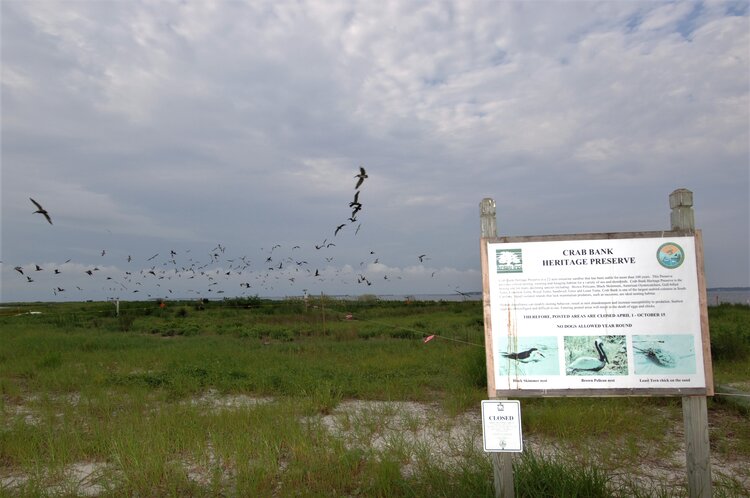
The Steward patrolled the beaches of Cape Romain — a key location for nesting birds north of Charleston — on weekends and holidays during the 2020 nesting season, interacting with beachgoers, and educating them about the presence of the birds and of the need to tread carefully to protect nesting seabirds and shorebirds. Shorebird Steward Jennifer Cahill also aided in installing closure signs and posts so that when the Steward wasn’t present, people could still be informed. The scope of this project recently expanded to include wintering shorebirds such as piping plovers and red knots. Another win for coastal birds in 2020 involved hiring an additional Shorebird Steward and Outreach Coordinator. This position will help further educate people about South Carolina’s coastal birds and connect people with projects that can make a difference in their protection.
![Shorebird Steward Jennifer Cahill places a sign on an island within the Cape Romain National Wildlife Refuge.. [SCDNR photo by David Lucas]](https://scdnrblog.com/wp-content/uploads/2025/02/dad85-caperomainseabirds-jcahill_dlucas_016.jpg)
Shorebird Steward Jennifer Cahill places a sign on an island within the Cape Romain National Wildlife Refuge.. [SCDNR photo by David Lucas]
Another important milestone was reached almost exactly one year ago. On February 6th, 2020, the U.S. Army Corps of Engineers, Charleston District exercised an option on their dredging construction contract for the Charleston Harbor Post 45 Deepening Project to place approximately 660,000 cubic yards of sediment within the historic footprint of the SCDNR-managed Crab Bank Seabird Sanctuary. Dredged material with a high sand content will be used to restore up to 80 acres of Crab Bank, approximately 28 acres of which will be prime nesting habitat above mean high water for coastal birds, creating a big win for the natural resources of South Carolina and the nation.
“Although 2020 has had its challenges, the increased appreciation of our shorebirds and the diversity among the groups involved in our fund-raising campaign give us hope that conservation of our coastal birds is achievable and a priority for the Lowcountry,” said Sanders. “SCDNR looks forward to a time when a successfully-restored Crab Bank will again allow the island to support nesting habitat for pelicans, terns and skimmers for many decades to come.”
Because of South Carolina’s importance for seabirds and shorebirds, SCDNR strives to protect, conserve, and restore habitats where and when it can. Shorebirds are some of the world’s most amazing migratory species. Many species nest in the arctic and sub-arctic zones of the globe and spend the winter in the Southern Hemisphere. During their travels, they stop in large groups to rest and fuel themselves to sustain their migration. South Carolina provides both stop-over sites for flocks of thousands of these migrating birds and wintering grounds for birds that do not travel as far south.
For example, South Carolina hosts the largest flock of red knots on the East Coast. In recent years, up to 8,000 of these federally listed shorebirds have passed through the Palmetto State on their epic migration. Red knots (pictured below) nest in the Arctic and winter at the southern tip of South America, a journey of 18,000 miles each year. South Carolina is also the most important wintering site for American oystercatchers, with half of the Atlantic population of this species visiting in the colder months. Seabirds, such as pelicans, terns, skimmers, and gulls gather in large groups to nest together in colonies during the breeding season. South Carolina has approximately 38 percent of all brown pelicans nesting on the Atlantic Coast, and some of the largest colonies of skimmers and terns in the Southeast.
![A migrating red knot looks for a meal on a South Carolina beach. [SCDNR photo by Felicia Sanders]](https://scdnrblog.com/wp-content/uploads/2025/02/36f4a-redknot.png)
A migrating red knot looks for a meal on a South Carolina beach. [SCDNR photo by Felicia Sanders]
But despite the efforts underway to protect them, coastal birds still face multiple challenges, including habitat loss and degradation, human disturbance, and increased predation. Of the 65 seabird, shorebird, and wading bird species, collectively known as waterbirds, that utilize South Carolina’s coastal habitats throughout the year, 47 are listed in the SC State Wildlife Action Plan as species of highest or high conservation concern, three are federally listed and five are state listed.
Shorebirds are of highest conservation concern due to small and highly threatened global populations. Shorebird populations alone have shrunk by 70 percent across North America since 1973 (Scientific American 2017). The coast of South Carolina is also the most rapidly developing area of the state, and much of this is occurring along shorelines, which has the potential to decrease abundance and distribution of coastal waterbirds throughout their life cycle. In addition, increased recreational use further limits available nesting and roosting habitat.
For these reasons, when the opportunity arose to partner with the U.S. Army Corps of Engineers and restore the former seabird sanctuary Crab Bank in Charleston Harbor as part of the Post-45 Charleston Harbor Deepening project, SCDNR jumped at this once-in-a-lifetime chance. Support from Audubon South Carolina, the S.C. Coastal Conservation League and the Coastal Expeditions Foundation enabled SCDNR to secure the necessary cost-share funds for the project. A new video about the upcoming restoration project produced by the Corps can be viewed on their YouTube.com video sharing channel: [https://www.youtube.com/watch?v=G21fcGhH2f4].
“This has definitely been an endurance race for the agency and our partners, as staff have committed time and energy to furthering this important restoration project,” said Lorianne Riggin, Director of SCDNR’s Office of Environmental Programs. “We are excited to share that we are nearing the end of the race and looking forward to restoration of Crab Bank getting underway sometime in the Fall of 2021.”
Conservation of birds that fly across the hemisphere can only be achieved through cooperative, far-reaching plans and efforts. Each location along a flyway is a critical link in the chain of sites birds use on their annual migrations. South Carolina voiced its commitment to preservation of local bird habitat when local small businesses, large corporations, students, individual citizens, nonprofits and government agencies all came together to raise funds for the restoration of Crab Bank and to continue working on coastal bird conservation for years to come via the S.C Coastal Bird Conservation program (SCCBC). The program’s goals include educating the public, protecting and enhancing habitat, and conducting research to better understand stressors to coastal bird populations.
To learn more about how you can help coastal birds and support the work of the SCCBC, visit www.sccoastalbirds.org.
 SCDNR Blog