
By Cami Duquet
The sun is rising over Captain Sams Inlet. It’s a calm mid-May morning, as the tide gently comes in, a group of people are burying an old and fringed brown net into the sandy beach. This group, made up of biologists and volunteers, take great care to camouflage the net with sand and pieces of wrack— so that just perhaps, a flock of unassuming red knots might land in front of it.
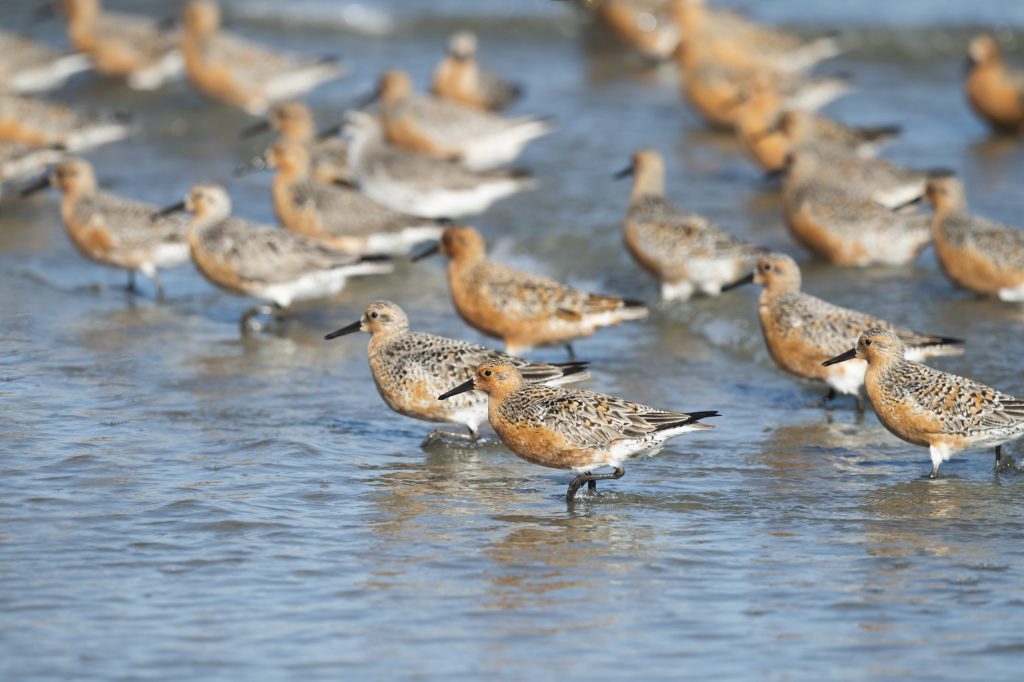
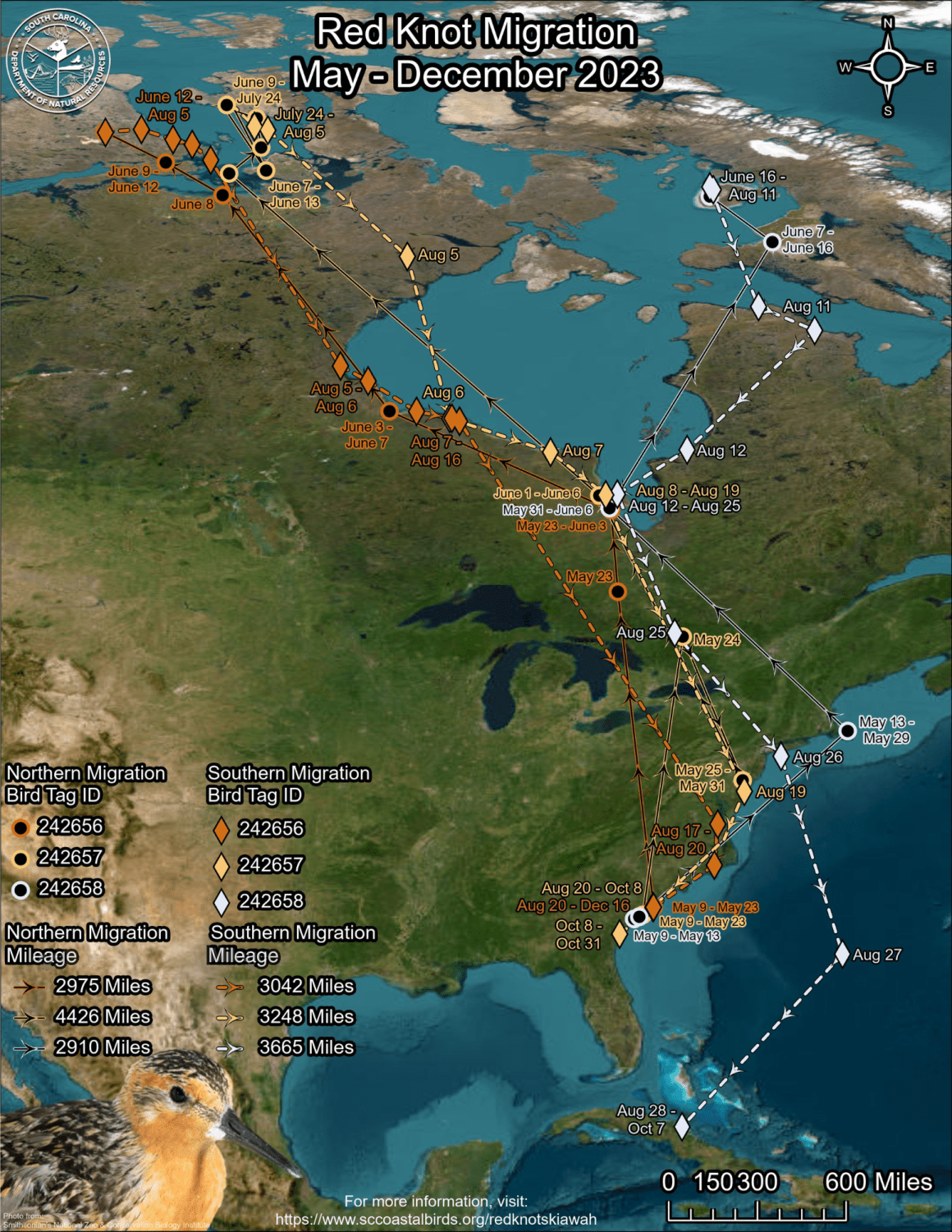
Red knots are federally threatened shorebirds that migrate through South Carolina on their way to their breeding grounds above the Arctic Circle. Between the months of March and May, they congregate in flocks of thousands, notably on the islands of Seabrook and Kiawah, to feed and rest along their journeys. Some come from as far away as the southern tip of South America.
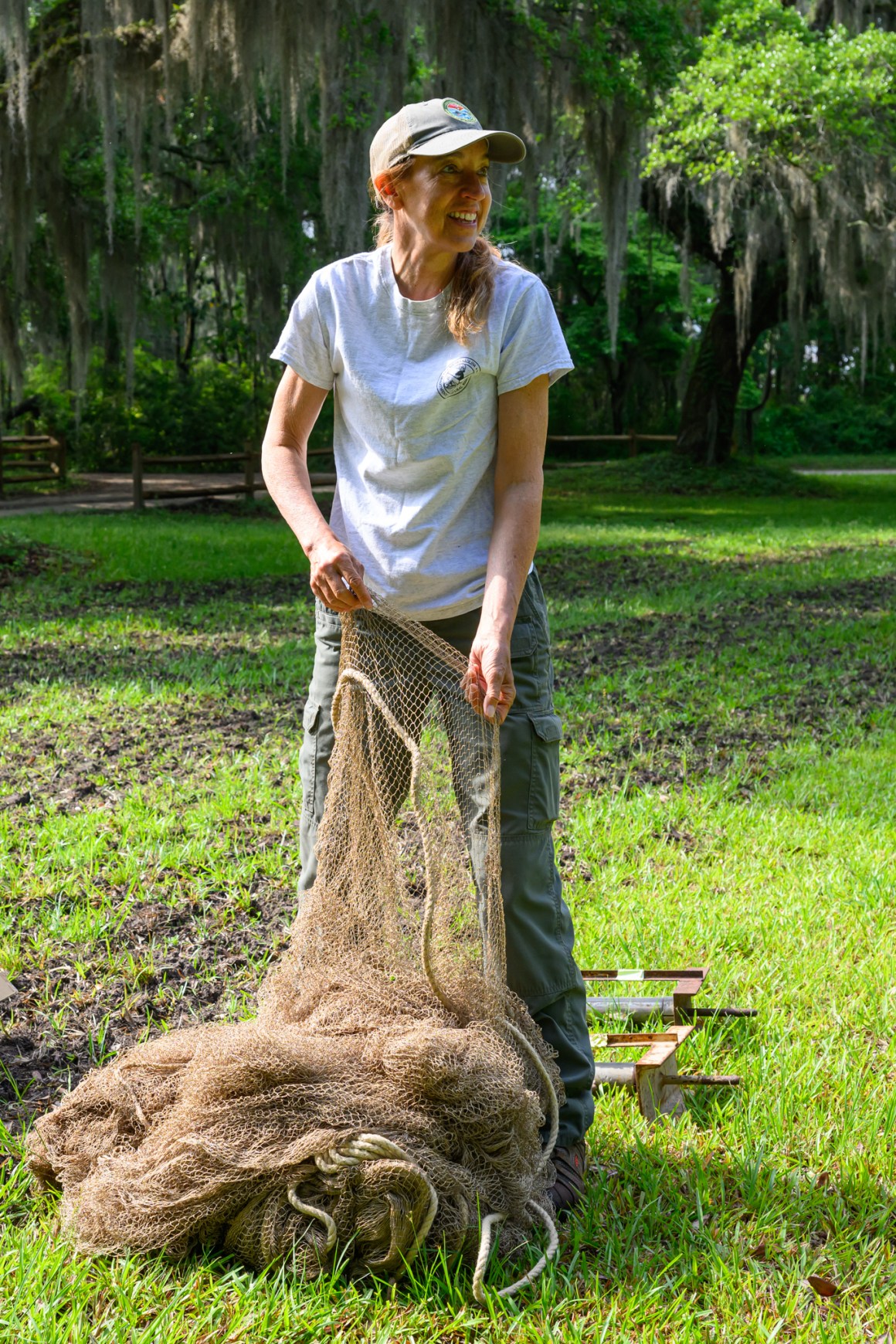
For over two decades, Felicia Sanders, wildlife biologist and coastal bird program coordinator at SCDNR, has studied these world migrants.
“Location data from tagging projects showed that most red knots in South Carolina fly directly towards the Arctic after leaving South Carolina beaches,” Sanders says. “While here, the knots rest, feed, and prepare for their northward migration. Through trapping efforts, this research identified our beaches as crucial for red knot survival.”
Shortly before high tide, the net is set. The group goes into hiding behind the dunes. The wait begins. At first, the red knots prefer the other side of the inlet on Seabrook Island— eventually the flock flies across to settle on the Kiawah Island side…getting closer to the net. They trickle in slowly and all of sudden, the flock gathers in front of the catch zone. It’s time.
“Fire” Sanders says. With the help of a little gun powder and projectiles, the net goes off. The catch is successful! More than a hundred red knots are carefully handled, measured, banded, and a lucky few outfitted with satellite transmitters.
Over the years, these trapping efforts have led to a much deeper understanding of red knot migration, their movements within South Carolina, and their protection.
As SCDNR is a close partner and collaborator of the shorebird steward program with Seabrook Island Birders, Sanders was recently invited to share the incredible findings from the May trapping efforts with their members and the greater Seabrook Island community. As the presentation program was coming to an end, the evening took a surprising turn.
Flashback to the old, fringed net used to catch the red knots. That net had seen over a decade of trapping attempts and replacing it would not come easy. The net uses a specific mesh and requires custom assembling, only done overseas in Wales, to be fitted for the particular purpose of catching shorebirds on the beach.
Seabrook Island Birders members and dear friends of the SCDNR Coastal Bird Program had identified the need for a new net to continue the important protection and research efforts—one could say they ~flew~ into action.
Mark Andrews, a member of the Seabrook Island Birders who leads the shorebird stewardship group on the island, had the idea for the fundraiser.
“A lot of excitement was generated on Seabrook Island by the story of the three satellite-tagged knots when we shared it with the community last fall,” Andrews says. “Seabrook Island Birders board member Bob Mercer and I had talked about a fundraiser to buy satellite tags, but each one was so expensive. Then I remembered a conversation that I had the year before with Felicia about how old her net was and the idea to buy a net was born. It’s the most essential instrument in the operation – you don’t get to follow the flight of satellite-tagged knots without catching them first. Bob ran with it.”
Mercer led the rest of the evening, following Sanders’ presentation with a fundraiser to gather enough donations to purchase a new net for Sanders’ program. A net-o-meter was projected on the wall and gifts came pouring in from the people in the audience, raising enough funds for a new net and more to go towards the Coastal Bird Conservation Fund.
Purchasing this new net simply would not have been possible without the kindness and generosity of shorebird stewards, Seabrook Island Birders, Seabrook island community members, and all who were in attendance that night. This new net, making its debut this year, will continue to contribute towards research of red knots and other shorebirds in South Carolina and beyond. “This essential equipment will allow us to continue learning about the amazing journeys red knots undertake each year across the hemisphere.,” Sanders says.
The SCDNR Coastal Bird Program would like to sincerely thank the Seabrook Island Birders and all the donors who have contributed to this generous gift for the program.
 SCDNR Blog