
By: Daniel Holt, SCDNR Archaeology Intern
Acidic cardboard boxes, 30+ year old plastic sandwich bags, rusting artifacts, and mold have all become the modern archaeologist’s nightmare. Less than 50 years ago, freshly dug artifacts were hastily curated in the wake of extensive excavations for sites across the United States. Unfortunately, the Childsbury Towne site was not an exception.
A site dating back to the early 18th century, Childsbury was colonial settlement situated near the frontier of the early Carolina backcountry. North of Charleston and along the vast Cooper River, the town acted as a small commercial center that was financially backed by elite residents from the area. Housing artisans, tradesmen, and other professionals, in addition to some of the elites, the site acted as a cog in a greater export market (Barr, 1996: 112-113). As the development of the plantation system began to take hold in the Carolinas, Childsbury and other small towns were choked out economically and largely abandoned.
The site returned to the spotlight when an archaeologist selected it for further study as the focus of his master’s thesis in the mid-1990s. A prime and rare example of a smaller colonial town with water access in South Carolina, it provided both terrestrial and marine opportunities for excavations. Over the course of his study, archaeologists excavated several units and conducted a couple hundred shovel tests to locate the remains of prominent structures at the site. Archaeologists in the 1990s successfully located evidence of structural remains, and they collected various artifacts such as ceramics and nails during their excavations. Following excavations, some of these artifacts were catalogued and stored according to the curational standards of the 20th century. Despite some of these artifacts being catalogued, entire boxes of artifacts were left without provenience and in their initial, paper excavation bags.
Just prior to the summer of 2024, the artifacts from this legacy collection were acquired by the SCDNR Archaeology team. The collection was in need of proper housing and conservation, and landed in my lap right as I needed a topic for my senior thesis at the University of South Carolina. With previous work on legacy collections, this project was not outside of my experience with other artifact assemblages. The major drawback of the project is that almost all the original paperwork completed in the 1990s was not stored with the collection and is currently missing. Without these critical archaeological fieldnotes and other paper records, artifacts’ context is largely lost and leaves many new open questions unfit to be solved without further excavations at the site.
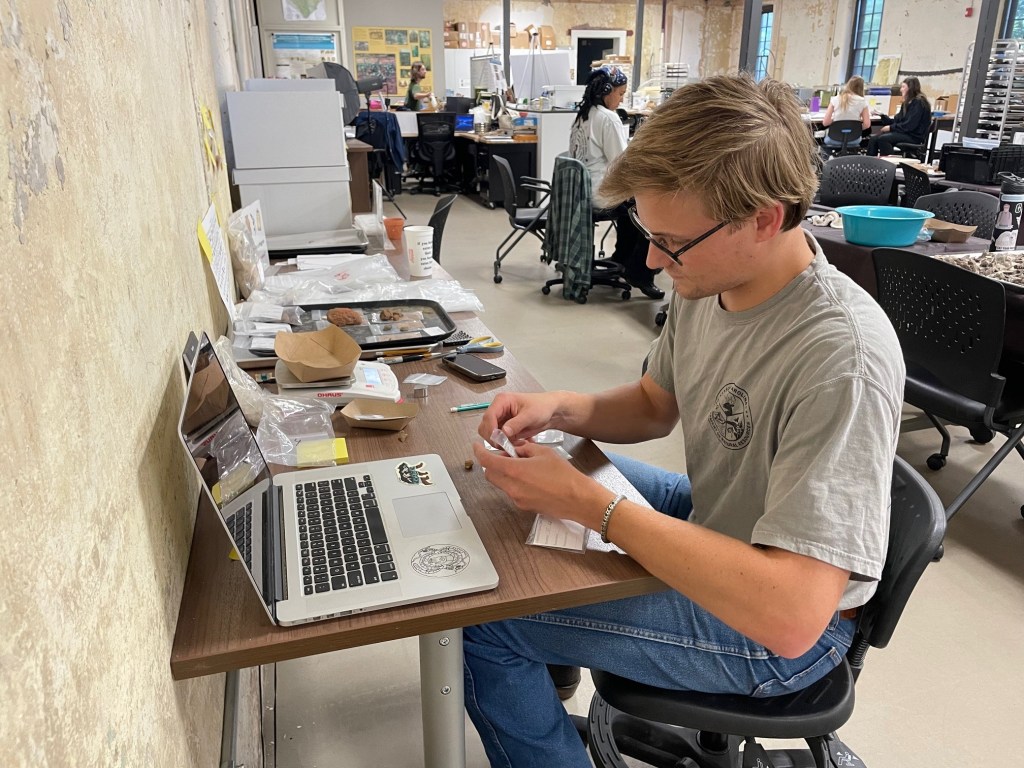
With all of this in mind, my duties laid in adjusting the curation of the artifacts to meet modern standards. With well over 1,000 artifacts in the assemblage, the task will extend past the traditional time boundaries of the internship. Thus far, 900+ artifacts have been accounted for and catalogued. Despite this, documents still need to be located that will allow archaeologists to inquire about the complexities of the site and its sociocultural impact on the Lowcountry of the Carolina colony. To finish this project will require the completion of the curation process, the tracking down of additional documents, and conservation of metal artifacts in the collection.
Despite the issues that I am facing with the collection, the assemblage has proven to be fascinating. The site offers many opportunities to explore the intricacies of the colonial Lowcountry of South Carolina and opens several questions pertaining to trade, enslavement, societal norms, and Colonial Era town planning. Due to all of this, I am very appreciative of this opportunity from the South Carolina Department of Natural Resources Heritage Trust Program and look forward to making further strides with the project as the year continues.

Childsbury Workspace in July of 2024.

Example of the state of original bags/collections prior to re-curation efforts.

Daniel Holt at lab workstation.
Barr, William B.
1996   Strawberry Ferry (38BK1723) and Childsbury Towne(38BK1750): A Socio-Economic Enterprise on the Western Branch of the Cooper River, St. John’s Parish, Berkeley County, South Carolina. Research Manuscript Series. 208. http://scholarcommons.sc.edu/arcanth_books/208
 SCDNR Blog