
By: William Wang, SCDNR Archaeology Intern
During my time at the South Carolina Department of Natural Resources (SCDNR) Archaeology Internship Program, I had the chance to experience and learn about a plethora of types of archaeology, from experimental archaeology to underwater archaeology.
However, one subject, photogrammetry, stuck with me throughout my internship. Photogrammetry as it pertains to archaeology deals with digitizing archaeological artifacts, such as arrowheads and coins, into 3D models. This is accomplished by taking numerous pictures of an object from different angles and using computer software to stitch together a 3D model from those pictures. Led by fellow intern, Charles Scarborough, who was already experienced with photogrammetry and had worked with photogrammetry at SCDNR before, this is exactly what I did.
We started off digitizing a set of jugs from the Horse Creek Heritage Preserve, which were set to be shipped to Monticello, Virginia in about a month. These large jugs provided a good introduction to the basics of Agisoft and Reality Capture, the two programs with which I would work with the most prominently. Such large jugs were much easier to photograph and easier for the programs to put together compared to tiny coins and sherds. After digitization, these jugs would be put onto a website known as Sketchfab to showcase them to a wider audience.
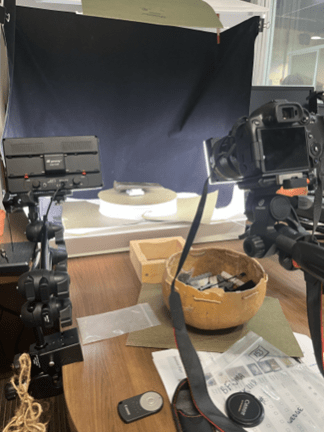
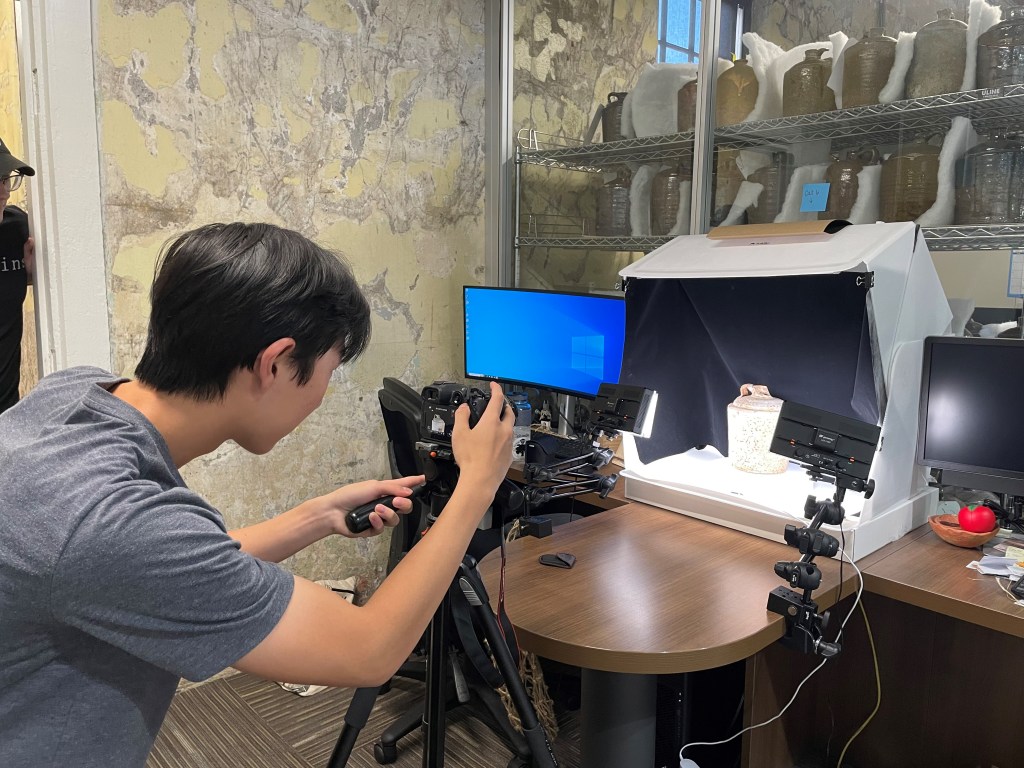
The workspace we used to take pictures of objects (Photo by William Wang)
However, the jugs were not without their difficulties. For one, most of the jugs were made out of reflective materials. Ordinary light shone onto the jugs would inevitably turn up in the final model, creating an inaccurate representation of the jugs. To solve this issue, Charles taught me to utilize a polarized lighting system. Polarized light is light that is passed through a filter, changing how it vibrates. Then, using a specific lens on our cameras, we can block out the reflected polarized light. In this way, while the jug is lit up, much of the unwanted reflections are eliminated, leading to more accurate models.
However, another problem soon emerged. When taking normal photos, much of the finer details of objects are missed due to a camera’s focus on a single point. Thus, much of the photo is blurry and cannot be used. Normally, this wouldn’t be a problem. SCDNR had recently acquired a new camera, equipped with a function known as focus stacking. When focus stacking was selected, the camera would take a rapid succession of pictures of a single angle of a jug, with its focus continually shifting across the jug. In this way, the camera could stitch together many images with different focuses, creating one final high-quality picture.
Theoretically, this was a straightforward process. However, soon after we started, our new camera began to malfunction, crashing after every single picture taken. Focus stacking wouldn’t do us any good if the camera didn’t work after all. So while we sent the camera for repairs, we had to make do. Since the pictures, now taken with an older camera, were focused only on one area, we had to go through each picture and, in a tedious masking process, cut out any blurry areas for hundreds of different photos. Scanning and digitizing, which originally took an hour or two at most, were stretched into day-long affairs not just for jugs, but any other items we needed to scan. Furthermore, this process was far more susceptible to human error and lower-quality models. Nevertheless, it was our only option.
Examples of 3D jugs on Sketchfab. They can be rotated, viewed in VR, and many have annotations to describe interesting features (Taken from SCDNR’s Sketchfab page)

Even with such difficulties, we were able to finish scanning the jugs and even eventually got the camera back. Now, looking back at my internship, I realize the importance of the work I did. These archaeological artifacts, which have survived hundreds or even thousands of years buried beneath the Earth, have now been unearthed and, through my experience at the internship, I realized just how fragile and vulnerable these artifacts are. Whether it be flooding, mismanagement, fires, or more, there are nigh-infinite ways that such artifacts can be destroyed. However, by preserving them on the internet in digital form, these objects can be preserved forever, safe from nearly all threats; and a way to remember the cultures that created these objects and their accomplishments forever.
 SCDNR Blog