
Have you ever wondered what it’s like to turn a passion for conservation into a full-time career? At the South Carolina Department of Natural Resources (SCDNR), a wide range of dedicated professionals work every day to protect our state’s natural treasures.
Today we’re sharing insights from three SCDNR team members – a law enforcement officer, a wildlife biologist and a captain – who each work on the coast and bring a unique perspective to the work they do. Read on to learn about the paths they took to careers in conservation, the challenges and rewards of their roles, and what inspires them to protect South Carolina’s natural resources.
Rhett Bissell
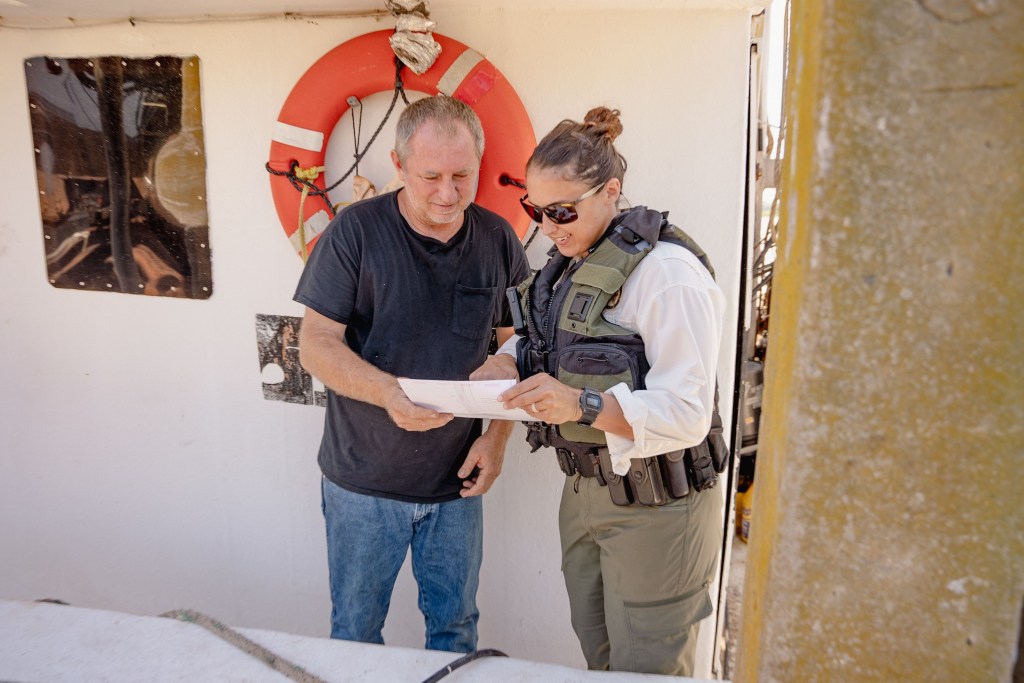
Law Enforcement Officer – Field Operations, Region 4
What are three skills you wish you’d learned before entering this field?
An unexpected part of our job in law enforcement is being pretty self-sufficient. I wish I had learned things like basic boat and equipment trailer maintenance – things like changing out tongue jacks or wench straps. As simple as those skills may sound, that’s something I think a lot of people don’t think about when they’re entering a field like this. We’re often by ourselves in remote areas with limited cell coverage, so having those kind of problem-solving skills to troubleshoot equipment issues on the fly goes a long way. I would also encourage people to look into boating courses or to pick up some sort of outdoor hobby if you don’t already have one, especially if you’re interested in the law enforcement side of conservation.
Having hobbies, like hunting, fishing, boating, etc., under your belt before you come into the field helps with the learning curve of the job and gives you an edge when it comes to learning the more in-depth laws of the state. It helps put the more complicated laws into a real-world application on the job, like making it easier for you to educate the public on a topic or law related to one of those activities. Lastly, developing your public speaking skills would be incredibly beneficial. I think people often forget that a necessary part of law enforcement is being able to talk to people and think quickly, but smartly. That comes from having solid communication skills, and I think practicing public speaking is one of the best ways to do that.
What part of your job came as a surprise to you when you started?
The most surprising part of this job was how different every day is. No day is like the other and there is always something going on. It’s a fast-paced work environment here on the coast for law enforcement, and we do a lot more than most people might think. You’re responsible for maintaining case files, doing routine patrols both in a truck and a boat, and interacting with the public in a variety of ways, not just routine stops. You’re participating in fishing rodeos, media events and youth hunts. There’s a lot to do from a fieldwork standpoint as well. Seasons come and bring unique enforcement action with each one. You won’t patrol in the same ways or even at the same times depending on the seasons, which makes the scheduling very different from your average law enforcement. But, I think it’s what I like most about the job.
What career path did you take to get to your position?
I got my college degree in Environmental Studies with a concentration in Policy and Government Relations from the University of South Carolina. I knew I wanted to be in some kind of law field related to that, so I pursued different opportunities. I was a paralegal for a few years but wanted a change. I had grown up hunting, fishing, and boating and knew that’s what I wanted to follow instead of being at a desk. I happened upon an opening for an administrative assistant with the law enforcement division in Charleston and never looked back! A few months later, I applied for a law enforcement officer position as a game warden and got the job. It’s been the best career decision I could have made.
How has this career made an impact on your life?
This career allows me to combine all of the things I’m truly passionate about. I get to educate people on fishing, hunting, and boating in a meaningful way, and I get to be in the outdoors every day. Not only that, I take those outdoor educational opportunities outside of work by volunteering for a local conservation non-profit that actively pursues ways to help children get more engaged in the outdoor community, especially those who wouldn’t normally have those opportunities. It’s an incredibly powerful thing to be able to combine what you love and what you’re passionate about into a career, and I love getting to do that every single day. I am very grateful and blessed to be able to say that, and I enjoy every aspect of this career, even the tough parts.
What is a fun fact you wish people knew about your job?
I wish people knew that there is more to being a game warden than just riding around in a truck, even though that is pretty cool! You can be a K9 handler, a diver, an investigator, or a member of our saltwater enforcement team. There’s a tremendous amount of training opportunities that can really help you narrow down a track to follow within the law enforcement division even if you don’t want to pursue a specialized team. Fieldwork is really diverse and there can be a lot of avenues to explore depending on your assigned area or what is in season.
Liz Vinyard
Wildlife Biologist – Marine Resources Research Institute, Estuarine Finfish Section


What are three skills you wish you learned before entering this field?
I wish I knew more about being on boats! How to captain, how to tie knots and secure a boat, and most importantly how to read the water (currents, tides, winds, underwater features, etc.). That was the biggest learning curve for me!
What part of your job came as a surprise to you when you started?
After I started, I couldn’t believe I was actually getting paid to be outside on a boat catching fish!
We frequently work 12+ hours, and in the fall during longline season, we’ll work up to 16 hours a day. For the most part, our surveys are determined by tidal cycles, weather conditions, and daylight so if those line up, we’ll work as long as possible to accomplish as much as we can.
What career path did you take to get to your position?
I had a very different career path from most of my coworkers. I worked in financial services for well over a decade before I was able to go back to school for my Bachelor of Science degree. Once I finished that, I knew I wanted to continue my education, so I came to the College of Charleston for my Master of Science in Marine Biology. I chose to conduct my thesis research with SCDNR to learn more about how scientific data is collected, processed, analyzed and shared – and to get my foot in the door if I ended up wanting to continue this type of work.
How has this career made an impact on your life?
This job is my lifelong dream come true. I’ve wanted to be a marine biologist since I was 5 years old, and this job has allowed me to develop a very diverse skill set. We are extremely fortunate at SCDNR that we are able to conduct all aspects of the scientific process in fisheries. We enjoy fresh air and sunshine while working on the water running gear and recording data on the fish we capture. The fish we bring back to the lab are worked up, and samples like otoliths, fin clips, and gonads are processed and analyzed. We’re then able to compile our data and share our findings with other scientists, students and the public through stock assessments, outreach and publications.
I always want students to know that even if you have to make detours in life, don’t ever feel like you can’t start over and pursue your passions. And many times, the skills you developed in other jobs/careers can be leveraged and used in a new way to help you see issues that might not be immediately evident to others.
What is a fun fact you wish people knew about your job?
Every day is different! My favorite part of this career is that there’s always something new to see or learn.
Jonathan D. O’Brien
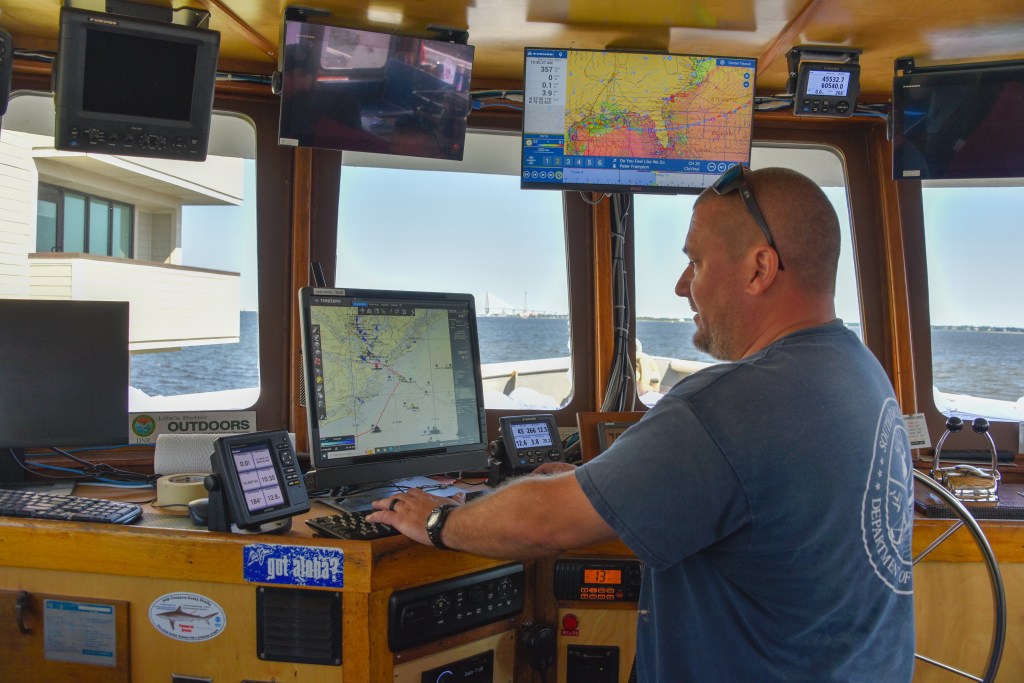
Watercraft Captain, R/V Palmetto


What are three skills you wish you’d learned before entering this field?
Before starting my job working on the R/V Palmetto, I wish I had more experience with welding, pipefitting, and a deeper understanding of diesel mechanics. Working aboard a 110’ steel-hull research vessel requires a wide range of skills and knowledge to operate safely and effectively.
What part of your job came as a surprise to you when you started?
Working on the R/V Palmetto, the crew is out at sea for up to 10 days at a time. I also work the midnight watch, so I’m on the wheel from 0000–0600 and 1200–1800. Being away from my family and working odd hours was a shock for me at the beginning. Even when you’re off shift, you’re always on standby in case something happens or you’re needed.
What career path did you take to get to your position?
I grew up around boats and on the ocean, so when I got older, I was naturally drawn to this type of work. I started working at marinas and on boats—mainly smaller center consoles—and then got into charter fishing and private boat deliveries for a few years. Eventually, I decided to step into working at a boatyard, learning more in depth about mechanics and how boats are built and repaired. I also spent a few years working on some commercial shrimp and fishing boats in the area before an opportunity arose for me to join the crew of the R/V Palmetto here at SCDNR.
How has this career made an impact on your life?
My job here with SCDNR has taught me a lot more about the importance of protecting our natural resources, particularly commercial and recreational fisheries. The work we perform on the R/V Palmetto has shown me that making our fisheries sustainable is of the utmost importance so that future generations can enjoy them. Working on the water is always a different experience, and the ocean never disappoints us.
What is a fun fact you wish people knew about your job?
As a Watercraft Captain, I’m not limited to just working on the R/V Palmetto. I’ve worked on several other vessels in the fleet—from dragging shrimp nets on the now-retired Lady Lisa to retrieving ocean gliders on the Silver Crescent. We have a great group of men and women here in vessel operations, and everyone does a great job making this career path a fun and exciting experience.
Resources
See all open SCDNR jobs here. – filter by Agency, Department of Natural Resources
 SCDNR Blog
Leave a comment